Baudelaire's "The Clock": The Poem That Inspired the Pomodoro Technique
Discover the Baudelaire poem that inspired Francesco Cirillo to create the Pomodoro Technique — the full text of L'Horloge in French and English, and the philosophy of time it unlocked.

Jonathan Griffin
Productivity Researcher
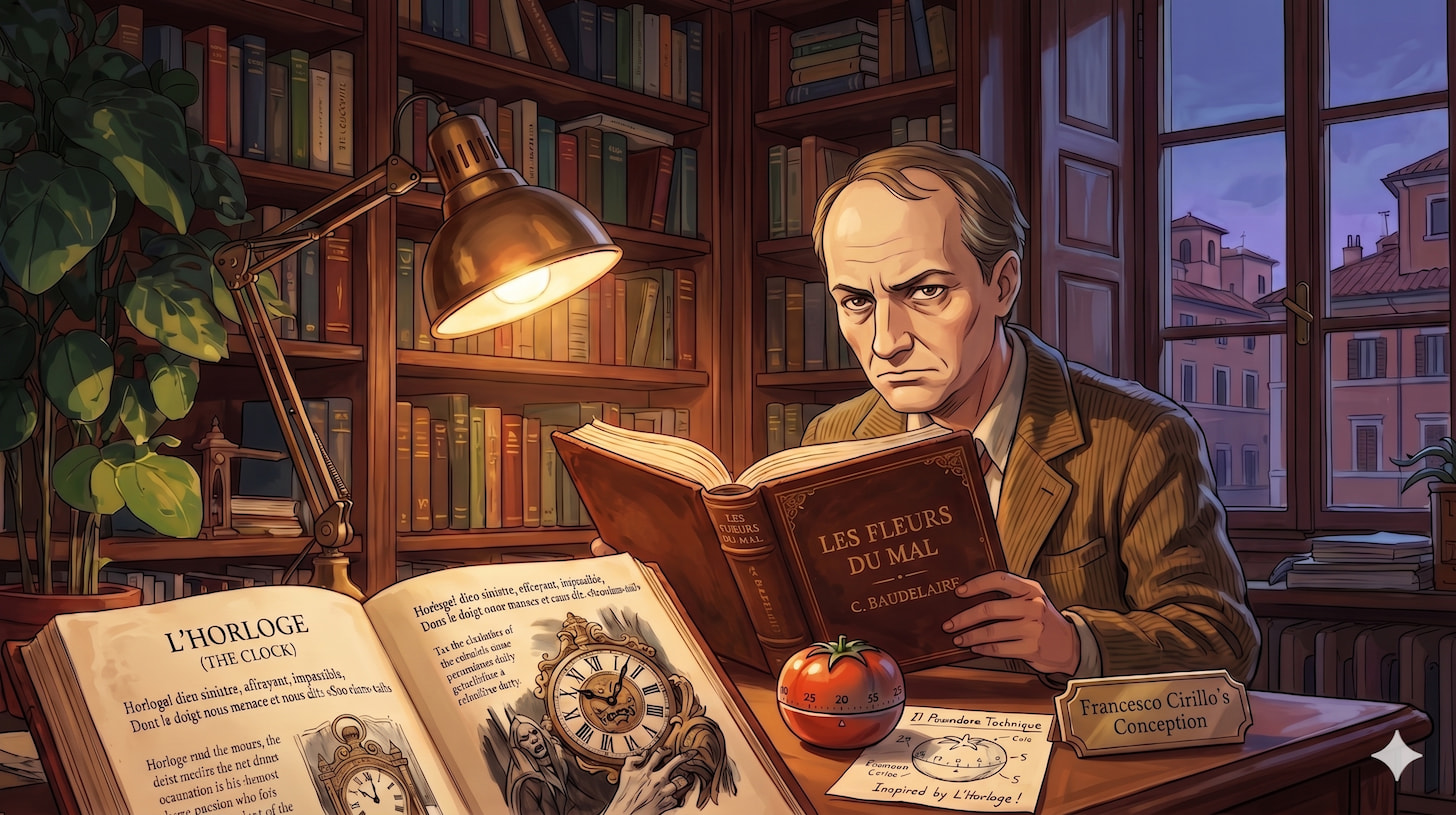
Most productivity guides open with a promise. Francesco Cirillo opened his with a single line of poetry. Before any method or framework, he placed one line from Charles Baudelaire’s L’Horloge (“The Clock”) at the head of his philosophical discussion of time: “Remember, Time is a greedy player who wins without cheating, every round!”
One line was enough to name the condition the technique was designed to cure: the experience of time as an enemy. This article gives you the full poem in the original French and in William Aggeler’s 1954 English translation, and traces the philosophy Cirillo drew from it to build the technique that answered it.
Table of Contents
The poem Cirillo used to define the problem his technique solves
A Technique That Begins With a Line of Poetry
The single Baudelaire line Cirillo used to define the problem his technique solves
Who Was Charles Baudelaire?
The poet who made time into a monster and why it still resonates
L'Horloge / The Clock
The full poem in French and English (Aggeler translation, 1954)
From Predator to Ally
How the Pomodoro Technique answers the poem
Additional Resources
Supporting sections and references
A Technique That Begins With a Line of Poetry
The single Baudelaire line Cirillo used to define the problem his technique solves
Before any method, framework, or step-by-step plan, Cirillo’s 2007 document opens its philosophical discussion of time with a single line of Baudelaire, placed as an epigraph[1]:
“Remember, Time is a greedy player who wins without cheating, every round!”
That line comes from L’Horloge (“The Clock”) by Charles Baudelaire, published in Les Fleurs du mal in 1861. One line, out of twenty-four. The one that named the problem precisely.
Cirillo did not reach for a scientific study or a productivity framework to define what his technique was designed to cure. He reached for a poem about being hunted by a clock. That choice tells you something important about what the Pomodoro Technique actually is — not a time-management system, but an answer to a feeling: the anxiety of watching your life slip through your fingers while you stand paralyzed and watching.
“Every day I went to school… with the disheartened feeling that I didn’t really know what I’d been doing, that I’d been wasting my time. The exam dates came up so fast, and it seemed like I had no way to defend myself against time.[1]
This is not a niche anxiety. It is the defining experience of the modern knowledge worker: the sense that time moves faster than you do, that every hour is simultaneously urgent and somehow already wasted. Baudelaire wrote L’Horloge in 1861. Over a century and a half later, a single line of it served as the opening epigraph of a productivity manual, because nothing had yet better captured what that manual was designed to solve.
The Pomodoro Technique is, at its core, an answer to this poem. Understanding what Baudelaire wrote, and why that one line resonated so precisely, is the fastest way to understand why the technique works.
Who Was Charles Baudelaire?
The poet who made time into a monster and why it still resonates
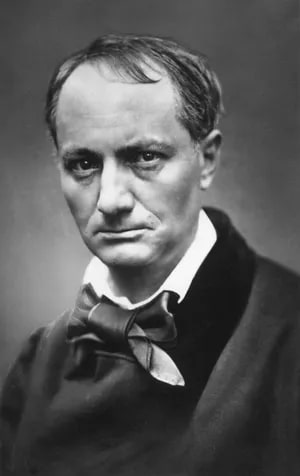
Charles Baudelaire (1821–1867) was a French poet whose work sits at the hinge between Romanticism and Modernism.[3] He was, by most accounts, a spectacular failure at life management. He squandered his inheritance, alienated his family, accumulated debts, and was prosecuted by the French government for the “obscenity” of Les Fleurs du mal (1857), the collection that would eventually be recognized as one of the greatest works in the French language.[3]
He was also, perhaps precisely because of this, the poet who coined the term modernity — modernité — to name exactly that sensation: the fleeting, perishable quality of life in a rapidly changing city.[3] Not time as an abstract philosophical concept. Time as something being devoured, right now.
This is the theme that runs through much of Les Fleurs du mal, and it reaches its peak in L’Horloge. Where other Romantic poets celebrated the eternal, Baudelaire zeroed in on the perishable. Where others wrote about what endures, he wrote about what is devoured. As Walter Benjamin observed, Baudelaire never let the crowd become “a stimulus to cast the plummet of his thought down into the depths of the world."[4]
The stanza Cirillo quoted from:
“
L'Horloge / The Clock
Charles Baudelaire, Les Fleurs du mal (1861)
Here is the complete poem, in French and in William Aggeler’s 1954 English translation, both now in the public domain.
L’Horloge
Charles Baudelaire, Les Fleurs du mal (1861)[5]
Horloge! dieu sinistre, effrayant, impassible, Dont le doigt nous menace et nous dit: «Souviens-toi! Les vibrantes Douleurs dans ton coeur plein d’effroi Se planteront bientôt comme dans une cible;
Le Plaisir vaporeux fuira vers l’horizon Ainsi qu’une sylphide au fond de la coulisse; Chaque instant te dévore un morceau du délice À chaque homme accordé pour toute sa saison.
Trois mille six cents fois par heure, la Seconde Chuchote: Souviens-toi! — Rapide, avec sa voix D’insecte, Maintenant dit: Je suis Autrefois, Et j’ai pompé ta vie avec ma trompe immonde!
Remember! Souviens-toi! prodigue! Esto memor! (Mon gosier de métal parle toutes les langues.) Les minutes, mortel folâtre, sont des gangues Qu’il ne faut pas lâcher sans en extraire l’or!
Souviens-toi que le Temps est un joueur avide Qui gagne sans tricher, à tout coup! c’est la loi. Le jour décroît; la nuit augmente; Souviens-toi! Le gouffre a toujours soif; la clepsydre se vide.
Tantôt sonnera l’heure où le divin Hasard, Où l’auguste Vertu, ton épouse encor vierge, Où le Repentir même (oh! la dernière auberge!), Où tout te dira Meurs, vieux lâche! il est trop tard!»
— Charles Baudelaire
The Clock
Translated by William Aggeler, The Flowers of Evil (Fresno, CA: Academy Library Guild, 1954)[6]
Impassive clock! Terrifying, sinister god, Whose finger threatens us and says: “Remember! The quivering Sorrows will soon be shot Into your fearful heart, as into a target;
Nebulous pleasure will flee toward the horizon Like an actress who disappears into the wings; Every instant devours a piece of the pleasure Granted to every man for his entire season.
Three thousand six hundred times an hour, Second Whispers: Remember! — Immediately With his insect voice, Now says: I am the Past And I have sucked out your life with my filthy trunk!
Remember! Souviens-toi, spendthrift! Esto memor! (My metal throat can speak all languages.) Minutes, blithesome mortal, are bits of ore That you must not release without extracting the gold!
Remember, Time is a greedy player Who wins without cheating, every round! It’s the law. The daylight wanes; the night deepens; remember! The abyss thirsts always; the water-clock runs low.
Soon will sound the hour when divine Chance, When august Virtue, your still virgin wife, When even Repentance (the very last of inns!), When all will say: Die, old coward! it is too late!”
— William Aggeler
A few details are worth pausing on. “Three thousand six hundred times an hour, Second / Whispers: Remember!” Baudelaire is describing a clock with mathematical precision. Three thousand six hundred seconds per hour. The clock is not a metaphor; it is the mechanism of your mortality, ticking at you 3,600 times every sixty minutes. The second has an insect voice: small, incessant, impossible to ignore once you hear it.
The final line is not addressed to someone who wasted their life in pleasure. It is addressed to the person who kept meaning to start, kept meaning to begin, kept letting the minutes go without extracting the gold.
From Predator to Ally
How the Pomodoro Technique answers the poem
Baudelaire’s clock wins because it is abstract and relentless. You cannot negotiate with it, measure it, or hold it still. It simply devours. This is the psychological experience Cirillo called “becoming”: the paralysing sensation of time as an undifferentiated force chasing you down, making every hour feel simultaneously urgent and futile.
The insight at the heart of the Pomodoro Technique is surprisingly simple. The problem is not time itself. The problem is your relationship with time. Abstract time, a vast invisible pressure bearing down on you, produces anxiety. Concrete time, a 25-minute interval with a clear beginning and end, produces focus.
The technique inverts Baudelaire’s poem by changing the unit. A 25-minute timer does not chase you. It gives you a fixed, bounded interval you can observe, track, and improve. The moment you wind the timer, you stop racing against an abstraction and start working within a structure. The clock is no longer a predator. It becomes a collaborator.
“I made a bet with myself, as helpful as it was humiliating: “Can you study – really study – for 10 minutes?” I needed objective validation, a Time Tutor, and I found one in a kitchen timer shaped like a pomodoro.[1]
Note what Cirillo called it: a Time Tutor, not a Time Manager. The goal was never to conquer time. The goal was to learn from it. Each Pomodoro is a controlled experiment. Each X on your tracking sheet is data about how you actually work, not a judgement of how fast you are. The abstraction becomes measurable. The predator becomes a teacher.
This shift in how you relate to every minute that passes is the entire philosophy. The tomato timer is just the mechanism.
Baudelaire’s second whispers Remember! 3,600 times an hour. The Pomodoro Technique gives you a way to answer it: I am working. And in 25 minutes, I will know exactly how much I have done.
Ready to make that shift? Start a Pomodoro session now, or read our complete beginner’s guide to walk through your first session, from choosing your first task to taking your well-earned break.
References
Sources cited in this article
- 1.Cirillo, F. (2007). The Pomodoro Technique (Version 1.3). Self-published. (Cited on p. 3)
- 2.Encyclopaedia Britannica. (2026, June 5). Charles Baudelaire. In Encyclopaedia Britannica. Retrieved 5 June 2026, from https://www.britannica.com/biography/Charles-Baudelaire
- 3.Charles Baudelaire. (2026, May 12). Wikipedia, Wikimedia Foundation.
- 4.Benjamin, W. (1983). The Flâneur [H. Zohn, Trans.]. In Charles Baudelaire: A Lyric Poet in the Era of High Capitalism. Verso. (Cited on p. 61)
- 5.Baudelaire, C. (1917). L'Horloge. In A. van Bever (Ed.), Les Fleurs du mal, 1857–1861 (p. 139). G. Crès. (Original work published 1861)
- 6.Baudelaire, C. (2008). The Clock [W. Aggeler, Trans.]. In J. Nygrin (Ed.), Les Fleurs du Mal / The Flowers of Evil (p. 341). Paskvil / Josef Nygrin. (Original translation 1954)