Pomodoro
Short Break
Long Break
25:00
Science-backed focus sessions for deep work. Customizable intervals, session tracking, and audio notifications, free, no signup required.
Looking for the theory behind the method? Read our Beginner's Guide to the Pomodoro Technique.
A simple, powerful timer built for deep work
Traditional 25/5/30, Sprint (15 min), Deep Work (45 min), or create your own custom intervals. Different tasks need different rhythms.
Enable auto-start to maintain seamless transitions between work and breaks. Stay in the zone without manual clicking.
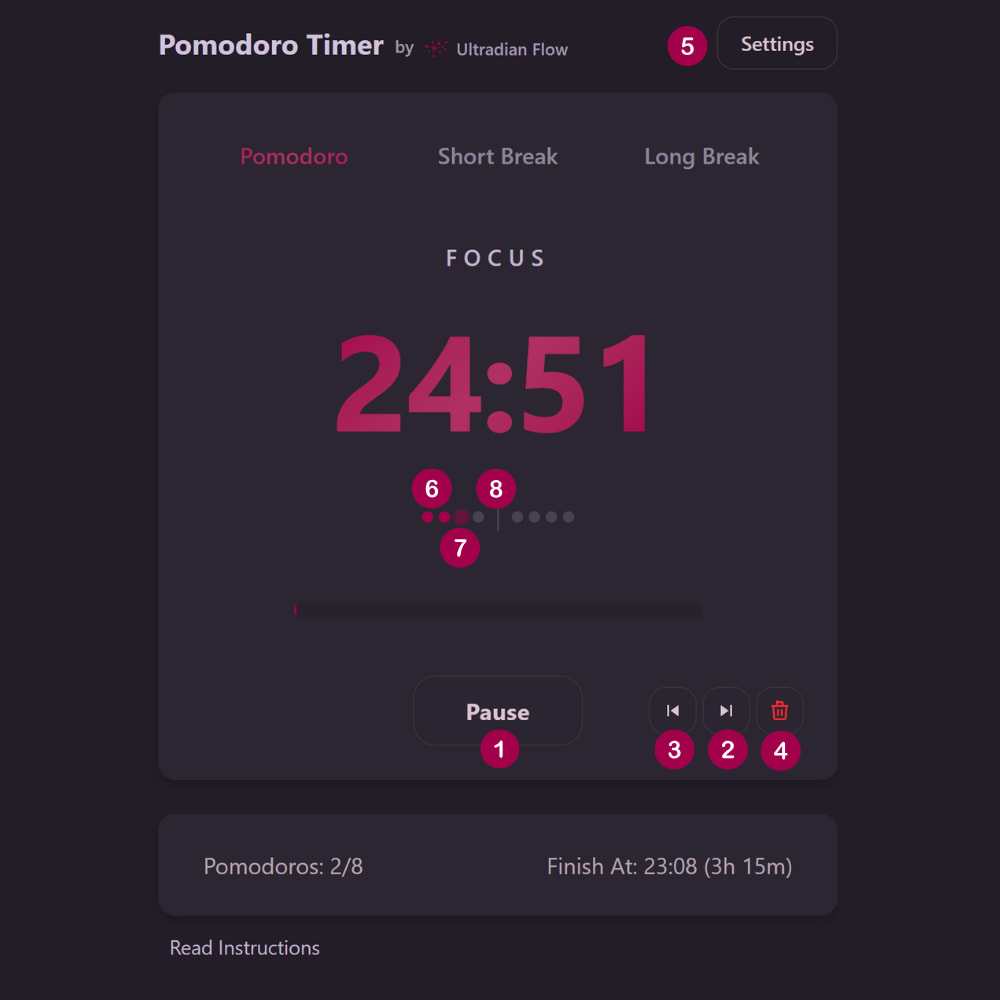
Session dots show completed Pomodoros, your current interval, and when your next long break arrives. See your momentum build.
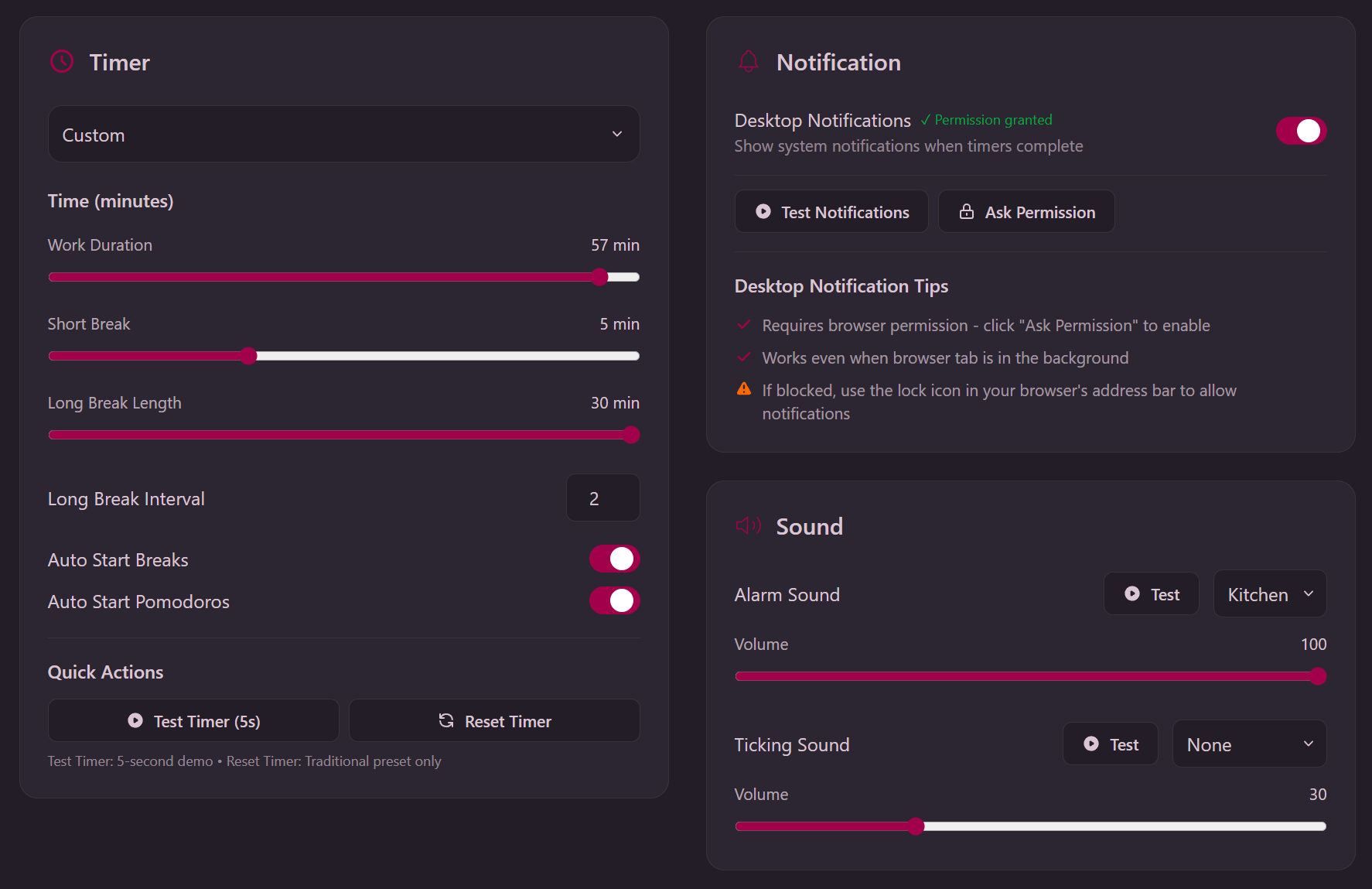
Multiple alarm sounds with adjustable volume. Desktop notifications keep you informed even when the tab isn't active.
Set your daily Pomodoro target and see an estimated finish time that updates as you complete sessions.
All your timer settings and preferences are stored locally in your browser. No accounts, no personal data collection. Just you and your work.
Journey through 180 years of groundbreaking discoveries that revealed how our minds and bodies really work. From the first biological clock experiments in 1842 to modern neuroscience breakthroughs.
Our capacity for sustained focus wanes after ~20 minutes for demanding tasks.
Pomodoro Connection: 25-min sessions end before vigilance drops.
Key Papers: Ariga & Lleras 2011; Ralph et al. 2020
90-120 minute physiological cycles of alertness and fatigue.
Pomodoro Connection: Four Pomodoros (~2 h) map onto one ultradian peak.
Key Papers: Kleitman 1963; Lavie 1983
Small wins release dopamine, reinforcing positive behavior.
Pomodoro Connection: Completing a Pomodoro and ticking a box equals a micro-reward.
Key Papers: Schultz 1997; Wise 2004
Work expands to fill the time available.
Pomodoro Connection: Fixed 25-min deadline squeezes task scope.
Key Papers: Parkinson 1955
We recall unfinished tasks better than finished ones.
Pomodoro Connection: Knowing a break is coming keeps tasks top-of-mind.
Key Papers: Zeigarnik 1927
Working memory has limited capacity for processing information.
Pomodoro Connection: Regular breaks prevent cognitive overload and maintain mental clarity.
Key Papers: Sweller 1988; Baddeley 2000
A step-by-step guide to using our Pomodoro timer effectively
Before you press start, decide what you want to accomplish today. Create a focused list of tasks you'll work on. You can use your favorite task management app or a simple pen and paper.
The goal is to commit to a set of priorities, preventing distractions from a larger backlog.
Download our To Do Today Sheet: PDF | Google Docs
Once you have your list, estimate how many Pomodoros each task will take. A good rule of thumb: break down any task requiring more than 5-7 Pomodoros into smaller chunks.
Record the number of available Pomodoros, assign them to tasks, and tick them off as you go.

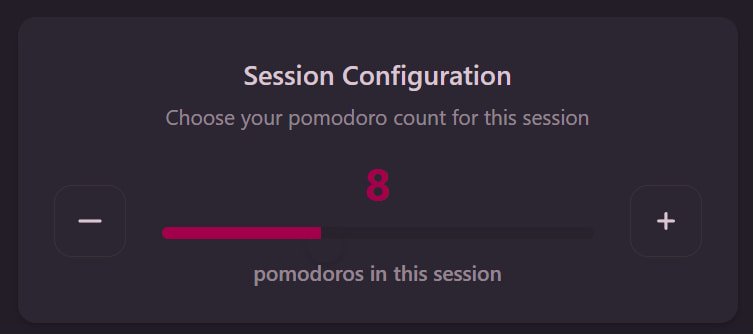
Below the main timer, use the session configuration to choose how many Pomodoros you want to complete (default is 8).
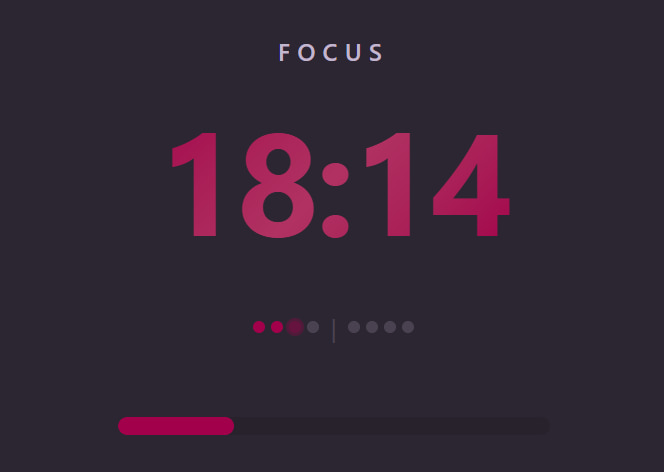
Click Start to begin your first Pomodoro. The timer counts down from 25 minutes. Work on your chosen task without interruption until the timer rings. The progress bar shows your progress through the interval.
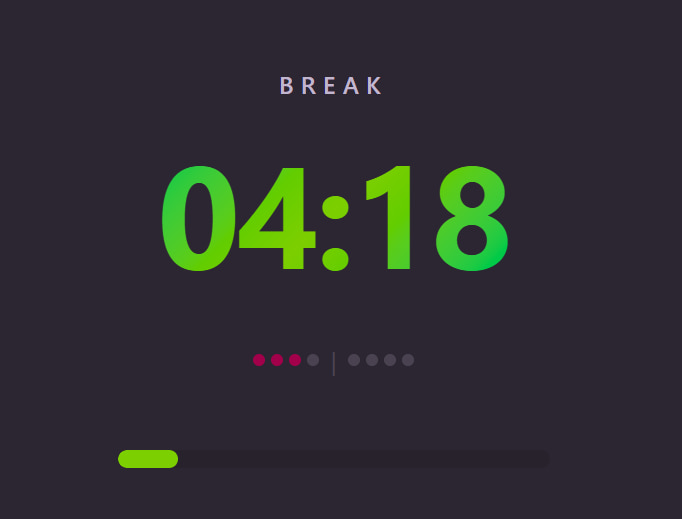
When the alarm sounds, take a 5-minute break. The timer automatically switches to "Short Break" mode if auto-start is enabled. After 4 Pomodoros, you earn a longer 15-30 minute break.
These break intervals align with your body's natural ultradian rhythms, the 90-120 minute cycles of alertness and fatigue discovered by pioneering physiologists in the 1800s.
What the interface means and how to control it
What separates effective Pomodoro use from just running a timer
A 25-minute Pomodoro is an atomic unit of work. It cannot be split. If you're interrupted, the Pomodoro is void. You should start a new one.
This isn't harsh. It's protective. It trains you to defend your focus time.
“A Pomodoro can't be interrupted; it marks 25 minutes of pure work. A Pomodoro can't be split up; there is no such thing as half of a Pomodoro or a quarter of a Pomodoro. The atomic unit of time is a Pomodoro.
The technique teaches you to identify interruption patterns and develop prevention strategies.
“Protect the Pomodoro means: inform effectively, negotiate quickly to reschedule the interruption, and call back the person who interrupted you as agreed. The Inform, Negotiate, Call Back Strategy enables you to control external interruptions by simply rescheduling them in a later Pomodoro the same day or another day according to the degree of urgency.
Completed your task before the timer rings? Use the remaining time to review and improve your work.
Reinforce what you learned. Spot areas for improvement. Don't just stop and wait for the bell.
“If you finish a task while the Pomodoro is still ticking, the following rule applies: If a Pomodoro Begins, It Has to Ring. It's a good idea to take advantage of the opportunity for overlearning, using the remaining portion of the Pomodoro to review or repeat what you've done, make small improvements, and note down what you've learned until the Pomodoro rings.
These aren't arbitrary restrictions. They're the difference between "I used a timer today" and "I actually got deep work done."
Everything you need to know about using the timer