The Original Pomodoro Technique PDF: Download Cirillo's Free Source Text
The original Pomodoro Technique PDF by Francesco Cirillo, first released free in 2006, and updated in 2007. What's inside, the full licence, three free worksheets, and a faster way to start.

Jonathan Griffin
Productivity Researcher
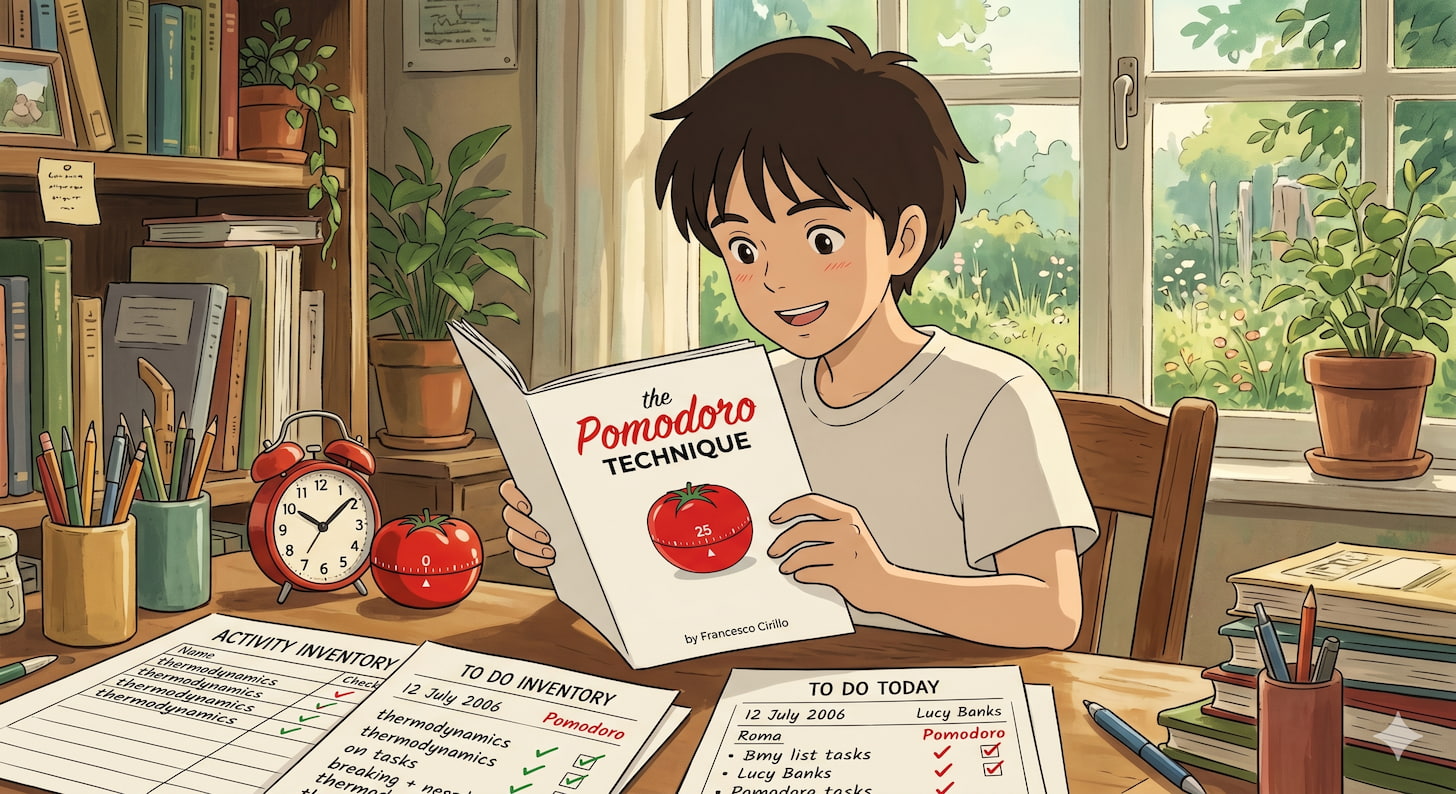
The original Pomodoro Technique was released by Francesco Cirillo as a free PDF in October 2006. The version in widest circulation, Version 1.3, was published 15 June 2007. It is licensed under Creative Commons Attribution-Noncommercial-No Derivative Works 3.0, which means it can be shared freely with attribution. The document covers the entire individual method: the three paper tools, the five objectives, and the five-stage daily process, in around 35 pages.
What most people discover quickly: you don’t need to read 35 pages to start. Cirillo designed the technique around radical simplicity: “many time management techniques fail because they subject the people who use them to a higher level of added complexity”[1]. A timer and a sheet of paper is all you need. The free pomodo.io timer gives you exactly that, digitally, with zero setup. No account, no configuration, no reading required.
Table of Contents
Everything about the original Pomodoro Technique PDF
The PDF That Started a Global Movement
Version history, dates, and how this document spread around the world
Download the Original PDF
Access the document, the full licence, and the attribution block
What's Inside: The Three Free Worksheets
The Activity Inventory Sheet, To Do Today Sheet, and Records Sheet explained
Free PDF vs. The Pomodoro Technique Book
What the free document contains vs. what you get in the paid edition
What People Ask Online
The licence, the versions, whether it's worth it: answered directly
Start Working, Not Just Reading
The fastest way to use the original method right now
Additional Resources
Supporting sections and references
The PDF That Started a Global Movement
Version history, dates, and how this document spread around the world
The Pomodoro Technique began as a personal experiment Francesco Cirillo ran on himself as a university student in the late 1980s. By 2006, after years of teaching the method in workshops and team mentoring, he published it as a free PDF.
The version history matters, because “2006” and “2007” both appear online and both are correct:
- Version 1.0: first published 19 October 2006. This is the original release.
- Version 1.3: published 15 June 2007. This is the version in widest circulation, including every copy currently shared across the web.
The document Cirillo published is titled The Pomodoro Technique (The Pomodoro). The 2007 Version 1.3 is the authoritative free text. There is no “official 2006 PDF” that differs meaningfully from the 2007 version. Version 1.3 is simply a refined update of v1.0 from the same year.
Why Cirillo released it free
This was a deliberate choice, not an accident. Cirillo had been refining the technique through workshops and wanted to document it clearly. As he wrote in the document itself: “There’s a need for me to explain the Technique as I conceived it. My hope is that it can help others reach their goals for personal improvement, and that I can further develop my original idea."[1]
The technique spread partly because the barrier to entry was zero. No purchase. No registration. A kitchen timer and a few sheets of paper. That accessibility was the whole point.
What this document is not
The 2007 PDF focuses on individual use: one person, five progressive objectives, 25-minute blocks. The later commercially published book (see Section 4) adds team-focused material. If you want to practise the Pomodoro Technique for your own work, the free 2007 document contains everything you need.
Download the Original PDF
Access the document, the full licence, and the attribution block
The file you are looking for is titled:
Cirillo - The Pomodoro Technique (The Pomodoro).pdf
This is the same file shared across university servers, productivity blogs, and community archives around the web. You can download the Pomodoro Technique PDF (Version 1.3, 2007) here.
This Version 1.3 (2007) copy is hosted here in accordance with the CC BY-NC-ND 3.0 licence[2]. No ads, no trackers, no registration required. pomodo.io is an independent timer application and is not affiliated with or endorsed by Francesco Cirillo.
Licence and attribution
This document is covered by a specific Creative Commons licence. Before you share, host, or redistribute it, this is what the licence says, verbatim from the PDF’s copyright page:
This work is licensed under the Creative Commons Attribution-Noncommercial-No Derivative Works 3.0 License. To view a copy of this license, visit http://creativecommons.org/licenses/by-nc-nd/3.0/
In plain terms:
- Attribution (BY): You must credit Francesco Cirillo as the author.
- NonCommercial (NC): You may not use the document for commercial purposes.
- No Derivatives (ND): You may not modify, remix, or build upon it. The document must be shared exactly as published.
If you redistribute or share this document, the required attribution is:
The Pomodoro Technique (Version 1.3, 2007) by Francesco Cirillo is licensed under Creative Commons Attribution-Noncommercial-No Derivative Works 3.0. © Francesco Cirillo 2006.
What's Inside: The Three Free Worksheets
The Activity Inventory Sheet, To Do Today Sheet, and Records Sheet explained
Before any timer, before any 25-minute block, the Pomodoro Technique gives you three paper sheets. These are the complete tracking infrastructure for the method. Cirillo described the full toolkit this way:
To implement the Pomodoro Technique, all you need is the following: A Pomodoro: a kitchen timer. A To Do Today Sheet, filled in at the start of each day with a heading, a list of tasks in order of priority, and an Unplanned & Urgent Activities section. An Activity Inventory Sheet where various activities are noted down as they come up and checked off when completed. A Records Sheet containing the date, description, and number of Pomodoros needed to accomplish each task — updated at least once a day, usually at the end of the day.[1]
Here is what each sheet does and how to use it.
1. The Activity Inventory Sheet
This is your master backlog, a persistent list of everything you need or want to do. You add tasks here as they arise throughout your life (projects, ideas, obligations, anything requiring focused effort) and cross them off when complete.
The Activity Inventory is not a daily to-do list. It is longer-horizon and undated. Its job is to capture tasks so they are not lost and to serve as the source for your daily planning.
2. The To Do Today Sheet
Every morning, you review your Activity Inventory and decide what you are committing to today. Those tasks go on a fresh To Do Today Sheet, in priority order. There is an “Unplanned and Urgent” section at the bottom for tasks that arrive unexpectedly during the day and cannot be deferred.
As you complete each 25-minute Pomodoro, you mark an X next to the task you worked on. The Xs represent “real effort”: actual time spent, not estimates or intentions[1].
The PDF appendix includes a blank, printable version of this sheet. If you prefer a digital copy you can edit, we have a free To Do Today Sheet on Google Docs. You will also find a step-by-step walkthrough of your first session in the Getting Started guide.
3. The Records Sheet
The Records Sheet is the most powerful of the three, and the most overlooked. At the end of each day, you transfer your completed Xs to this permanent archive: date, task description, and the actual number of Pomodoros it took.
Cirillo described its purpose directly: “Recording provides an effective tool for people who apply the Pomodoro Technique in terms of self-observation and decision-making aimed at process improvement."[1]
After a week of entries, patterns become visible: which tasks consistently take more Pomodoros than expected, which time slots produce the most completions, where your focus routinely breaks. This is the data that makes estimation (the technique’s third objective) actually accurate.
The timer and the sheets are deliberately separate tools
Cirillo designed the timer and the three sheets as distinct instruments with distinct jobs. The timer counts down 25 minutes and rings. The sheets capture what you planned, tracked, and learned. You run both in parallel, and he meant them to stay separate.
Most digital Pomodoro apps collapse this distinction by bundling a task manager into the timer. Cirillo saw that as the problem, not the solution: “Keep Tracking at the lowest possible level of complexity… Choose simple tools for this activity: using paper, pencil and eraser serves as a useful mental exercise."[1]
He was also specific about why automating the sheets gets it wrong: “To mark the end of a Pomodoro or to eliminate a finished activity from the To Do Today Sheet, Pomodoro practitioners should use explicit gestures. For this reason it’s better if these aren’t automated."[1]
This is the design principle the pomodo.io timer follows. The app provides the countdown. Nothing more. Your Activity Inventory, To Do Today Sheet, and Records Sheet stay exactly where Cirillo put them: separate from the timer, under your own control, in whatever form suits you. The original design, respected.
Free PDF vs. The Pomodoro Technique Book
What the free document contains vs. what you get in the paid edition
The 2007 PDF and the commercially published book are not the same document. Understanding the difference will help you decide what, if anything, you actually need to buy.
What the free 2007 PDF contains
The Version 1.3 document covers the complete individual Pomodoro Technique:
- The philosophical foundation: how Cirillo frames time as ally rather than enemy[1]
- The full toolkit: timer, Activity Inventory Sheet, To Do Today Sheet, Records Sheet[1]
- The five-stage daily process: Planning, Tracking, Recording, Processing, Visualising
- All five progressive objectives, from basic tracking (Objective I) through setting up a sustainable timetable (Objective V)
- Interruption management strategies, both internal and external
- The cognitive science rationale for 25-minute intervals and strategic breaks
- The Records Sheet methodology for self-observation and process improvement
For an individual practitioner, this is the complete system. There is nothing in the 2007 document that has been superseded or that requires the book to understand.
What the paid book adds
The commercially published edition adds significant content on team use. This includes how to apply the method in collaborative contexts, how to coordinate multiple practitioners, and lessons from Cirillo’s consulting work with development teams and organisations.
If you are implementing the Pomodoro Technique with a team, whether in a development sprint, a classroom, or a workshop, the book offers material the free PDF does not cover.
For a solo learner, the free PDF is complete.
The honest recommendation
Read the free document. If after practising the individual method you find you need the team extensions, buy the book directly from Cirillo’s official channels. Purchasing from the author is the straightforward way to support the work.
What People Ask Online
The licence, the versions, whether it's worth it: answered directly
These are the questions that come up repeatedly in Reddit threads, productivity forums, and search queries. Answered as directly as possible.
Is it legal to download the Pomodoro Technique PDF for free?
Yes, with conditions. The document is released under the Creative Commons Attribution-Noncommercial-No Derivative Works 3.0 License (see Section 2 for the verbatim text). Sharing and redistribution are permitted provided you: (1) credit Francesco Cirillo as the author, (2) do not use the document commercially, and (3) do not modify or repackage it. The document itself is not in the public domain, but the licence explicitly allows free redistribution with attribution.
Which version is the “original” Pomodoro Technique PDF?
Both “2006” and “2007” are correct, and the confusion is common. Version 1.0 was first published on 19 October 2006, which is the original release date. Version 1.3 was published on 15 June 2007, and is the version in wide circulation. The v1.3 document is the stable, definitive free text. If you have found a copy online labelled “2006,” it is likely the same v1.3 document or an earlier draft; they contain the same core method.
Is the free PDF the same as the paid book?
No, they differ in scope. The free PDF covers the complete individual method: five objectives, five-stage daily process, interruption management, and the toolkit. The commercially published book adds substantial content on team application. For solo practitioners, the PDF contains everything. For team leads or managers applying the method across a group, the book is worth the investment.
Does the free PDF include the worksheets?
Yes. The appendix includes blank, printable versions of all three sheets: the Activity Inventory Sheet, the To Do Today Sheet, and the Records Sheet. You can print the relevant pages directly from the PDF and start using them. If you want an editable digital version of the To Do Today Sheet, we have a free Google Doc you can copy and customise.
Where can I find it without ads, trackers, or sketchy downloads?
That is the main reason this page exists. Cirillo no longer hosts the free PDF himself; it has been superseded by the commercially published edition. The copies circulating across university servers and productivity blogs are the same legitimate file, but the surrounding sites vary in quality. We host Version 1.3 (2007) here with clean attribution, no ads, and a clear licence statement.
Do I need the PDF at all, or can I just start?
You can start without reading it. Cirillo designed the technique with five progressive objectives and is explicit that beginners should only focus on the first: finding out how much effort your work actually requires. Everything else (interruption handling, estimation, optimisation) comes later.
Our Getting Started guide is built around exactly that first objective. It walks you through your first session step by step, covering what to do when the timer rings, how to handle interruptions, and what a successful first day looks like. The PDF is worth reading once you have the rhythm, but it is not where you should begin.
Start Working, Not Just Reading
The fastest way to use the original method right now
Cirillo’s core argument for the original toolkit was this: “Employing easy-to-use, unobtrusive tools reduces the complexity of applying the Technique while favoring continuity, and allows you to concentrate your efforts on the activities you want to accomplish."[1]
The 35-page document exists to explain why the method works. The method itself can be used before you finish reading it.
You need:
- A task you actually need to do today
- A way to time 25 minutes
- Something to mark an X on when the timer rings
That is the entire system at its minimum. Everything else (the five objectives, the estimation methods, the Records Sheet) is added progressively as you practise.
A kitchen timer works perfectly and is exactly what Cirillo used. What matters, by his own criteria, is that the tool is easy to use and unobtrusive — it should not add complexity or pull your attention. The free pomodo.io timer meets that same standard: it provides the countdown, you keep your own sheets. No task manager bundled in, no built-in tracking that duplicates your To Do Today Sheet. Just the 25-minute interval, a ring, and a break. No account, no configuration, no download.
If you want the full walkthrough before you start, the Getting Started guide covers your first session step by step, including what to do when the timer rings, how to handle interruptions, and what a successful first day actually looks like.
References
Sources and citations for this article
- 1.Cirillo, F. (2007). The Pomodoro Technique (Version 1.3). Self-published. (Cited on p. 4, p. 2, p. 5, p. 8, p. 22, p. 28, and p. 1)
- 2.Creative Commons. (n.d.). Attribution-NonCommercial-NoDerivs 3.0 Unported (CC BY-NC-ND 3.0). Retrieved 6 June 2026, from https://creativecommons.org/licenses/by-nc-nd/3.0/deed.en