What to Do During a 5-Minute Pomodoro Break: It Has to Be a Real Mental Reset
The five-minute break is mental first. Here's how to drop the last 25 minutes, what to actually do, what to avoid, and why a real reset makes you catch mistakes and surface better ideas.

Jonathan Griffin
Productivity Writer & Developer

When the timer rings, you stop typing and call it a break. But stopping isn’t the same as resting. The five-minute Pomodoro break is mental first: its real job is to let you put down the last 25 minutes so you come back sharper and catch the mistakes you were too close to see.
To actually get that reset, the break needs to follow three core principles:
- Mental first: What restores you is a genuine sense of being away from the work, including the problems you haven’t solved yet [1].
- Rest beats switching tasks: Checking email or knocking out an admin chore doesn’t count. Real rest is what recovers your attention [2].
- The payoff is real: Short breaks reliably improve how you feel, with little to no average cost to performance [3].
This is the practical guide to what to actually do in those five minutes, and we’ll be clear throughout about where the advice comes from research and where it’s a sensible extension of it.
Table of Contents
The five-minute break, from the mental rule to the practical options and the science underneath
Stopping the Timer Isn't the Same as Resting
Why merely stopping fails, and the cutoff ritual that starts a real break
The First Move Is Mental: Put Down the Last 25 Minutes
Detachment as the rule, and the breadcrumb that frees your mind to rest
What to Actually Do: A Short List of Real Resets
Cirillo's simple options, why they work, and the manual-chore rule
What Not to Do: The Breaks That Quietly Backfire
Work, admin chores, the phone, and shortening the break under pressure
Why You Come Back Sharper
Perspective, catching mistakes, and letting hard problems incubate
The Science Underneath: Why Five Minutes Works
The invisible machinery: why even five minutes restores your attention, your recall, and your body
Short Break vs. Long Break: Keep the Short One Short
The two break lengths and why the short one must stay short
The Real Break Is a Reset, Not a Pause
The one-line answer, and why the putting-down is the point
Additional Resources
Supporting information
Stopping the Timer Isn't the Same as Resting
Why merely stopping fails, and the cutoff ritual that starts a real break
The timer rings. You stop typing, glance at your phone, maybe answer a message, and call that a break. But Francesco Cirillo , who created the Pomodoro Technique, is clear that this isn’t enough. A Pomodoro break “really has to be a break."[4]
Stopping work and actually resting are two different things. The five-minute pause only really works when you treat them differently, and the difference happens in your mind, not your body.
What makes a break genuinely restorative is the ability to mentally step away from the work, including the problems you haven’t solved yet. Researchers call this psychological detachment, and it is what actually allows your attention to recover.[1]
The good news is that you don’t need to leave the room to get it. Being away is a mental shift rather than a physical one, so even a change of focus at your desk can provide it.[5]
A five-minute break can be a real reset, as long as it is a break for your attention and not just your hands.
Give your mind a clear signal that the work is over. Close the laptop lid, switch the monitor off, or simply turn your chair away from the desk. A small, repeatable action like this makes it much easier to mentally step away when you only have five minutes.
While researchers haven’t tested this exact ritual in short breaks, the underlying idea is well supported. A large 2016 study found that people who lacked clear boundaries between work and the rest of their life struggled more to detach, and closing your laptop is a small, practical version of creating that boundary.[6]
The First Move Is Mental: Put Down the Last 25 Minutes
Detachment as the rule, and the breadcrumb that frees your mind to rest
Before you decide what to do with the five minutes, decide what to do with your mind. The first move is to stop replaying the Pomodoro you just finished.
Cirillo’s own framing is that the break is for disengaging, not for quietly continuing to chew on the task,[4] and that it should stay clear of anything that takes real mental effort.[4]
He treats stepping back to observe your own work as a skill you sharpen with practice, not something you are told once and simply have.[4] And he is emphatic about what that observing is worth:
“Stopping, detaching, and observing yourself from the outside enhances awareness of your behavior. Stopping becomes synonymous with strength, not weakness.[4]
There is a good reason replaying the last session backfires. When you switch away from a task, your attention does not switch cleanly with you. In a 2009 paper, Sophie Leroy called this leftover “attention residue”: a part of your mind stays stuck on what you were just doing, and it measurably drags down whatever comes next.
While Leroy originally studied people switching between two work tasks rather than stopping to rest, the mechanism still explains why a break feels strained when the task behind you is left hanging. The residue is heaviest when a task is unfinished, which is precisely the state a ringing Pomodoro tends to leave you in.[7]
The core point remains: stopping the timer is not the same as feeling done. A real break has to close the mental loop, not just the clock. Leroy also found that knowing you will return to the task soon, which the Pomodoro guarantees, may soften the effect.[7]
If attention residue is worst when a task is unfinished, give yourself a cheap sense of closure before you stand up. Spend ten seconds writing the exact next step, something like “Next: fix the API routing error on line 42”, or deliberately stop mid-sentence at a point where you already know what comes next.
In a series of experiments, making a specific, genuine plan for an unfinished goal freed people from intrusive thoughts about it, even though the goal itself stayed undone.[8] The catch is that the plan must be specific and sincere: a vague promise to deal with it later does not work, but a concrete note does. While those experiments looked at personal goals rather than a short work break, the underlying principle applies well here. This is especially useful if your main hesitation about taking breaks is the fear of losing your place.
What to Actually Do: A Short List of Real Resets
Cirillo's simple options, why they work, and the manual-chore rule
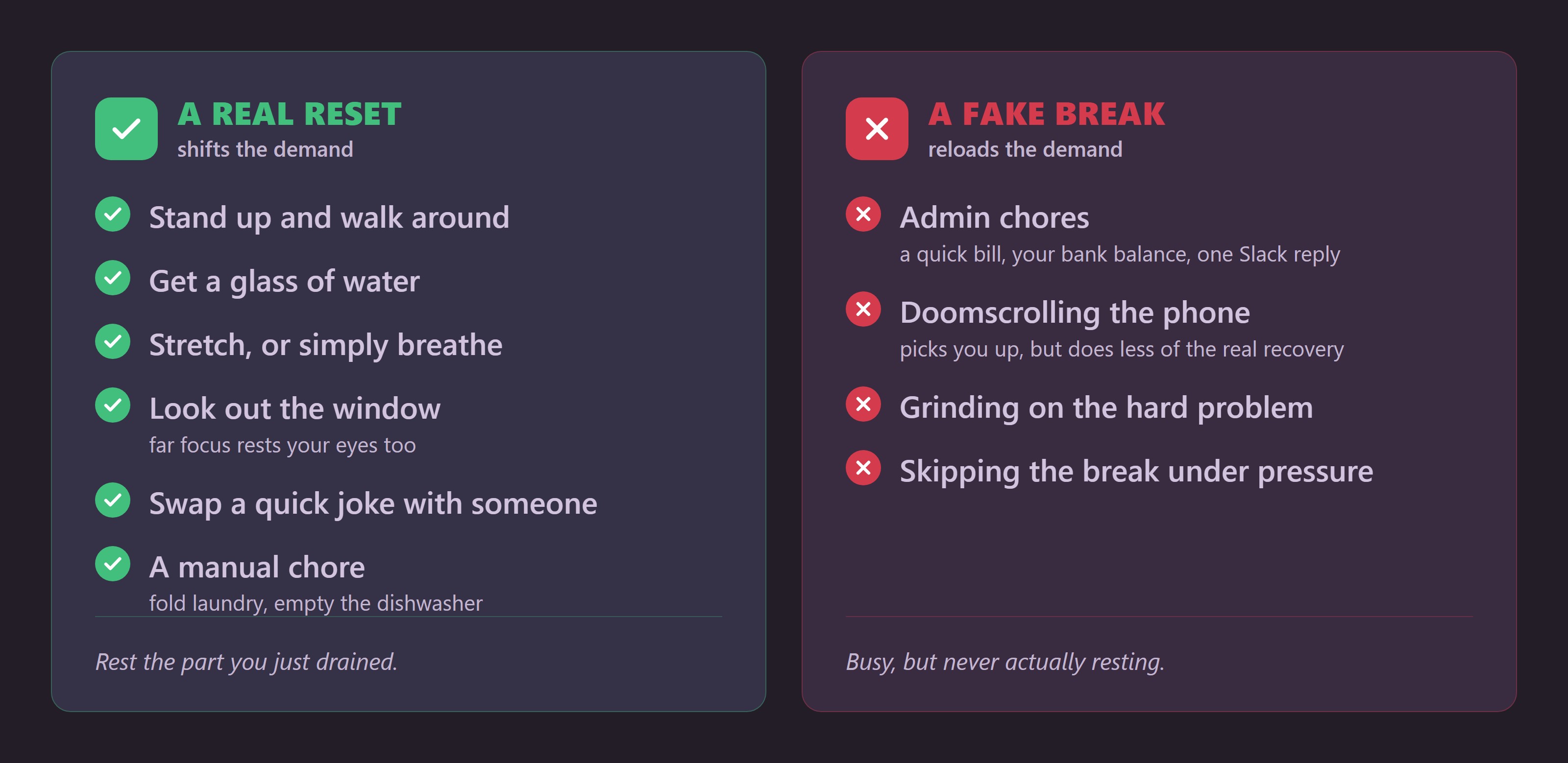
Now the literal question: what do you actually do? Cirillo’s own examples are deliberately small and undemanding:[4]
- Stand up and walk around the room to get the blood flowing.
- Get a glass of water to physically step away from the keyboard.
- Stretch, or simply breathe to release the tension you’ve been holding.
- Look out of the window to let your focus drift somewhere far away.
- Swap a joke with someone to shift your mental state.
The specific activity is not the point. Each one simply lets your mind release the work. And if a demanding urge surfaces while you are up, the kind that begins “I should just quickly…”, his advice is not to act on it but to note it down and give it its own Pomodoro later.[4]
The research explains why such low-effort activities work. Focused effort draws down a particular, fragile capacity: the directed attention you steer on purpose. The activities that restore it are the ones that hold your attention effortlessly instead, a gentle walk or a far-off view rather than another problem to solve.[5]
On the whole, simply resting tends to beat switching to a different task, so “do something else” is a fallback rather than the ideal.[2] And the most reassuring finding for anyone agonizing over the perfect break is that the act of taking one matters far more than its type.[2]
The payoff is real but bounded: breaks reliably lift your well-being and vigor, with a smaller and less certain effect on raw output. A 2022 meta-analysis of micro-breaks found exactly that,[3] which is the right way to hold it: the goal is to restore you, not to squeeze out more output.
Stephen Kaplan’s framework names the qualities that make an experience restorative, and a 2022 review adds a fifth, so the whole short list is worth keeping in mind.[5][2]
Kaplan names four; a 2022 review adds the fifth.
- Being away: a mental shift away from the work.
- Extent: enough room for the mind to wander a while.
- Fascination: something that holds your attention without effort.
- Compatibility: it suits what you actually feel like doing.
- A slower pace (the 2022 addition): no clock pressure.
Most of Cirillo’s list quietly ticks these boxes.
If you would rather move than sit still, the evidence is on your side, with a caveat about how strong it is. Brief activity that breaks up a long stretch of sitting gives an immediate lift in focus and decision-making, the kind measured right afterwards rather than built up over weeks. A 2026 review gathered these results, mostly from small, young, healthy samples, so read them as promising rather than settled.[9]
Where the review could be specific, the useful dose was roughly three minutes of moderate walking, and a moderate, whole-body movement such as a brisk walk or a flight of stairs did more for thinking than a slow stroll or fidgeting in your chair.[9] A brisk but easy walk is a good compromise: enough to help the body and the mind without tipping the break back into effort.
What Not to Do: The Breaks That Quietly Backfire
Work, admin chores, the phone, and shortening the break under pressure
Re-engaging your attention on another mentally demanding task does not restore it, no matter how busy it makes you feel.[5] The cost usually shows up later as a more irritable, more error-prone version of you for the rest of the afternoon.[5]
The phone is a slightly different case. It is not forbidden, but it is a weaker form of break. One workplace survey found that people felt re-energized after a phone break about as much as after a device-free one, but it did significantly less to reduce emotional exhaustion.[1] The constant small screen and fast pace keep your attention working instead of letting it rest. So reach for it knowing the trade-off: it can pick you up, but it does less of the deeper recovery.
Two more traps work in opposite directions:
- Don’t try to push through a hard problem during the five minutes. A short break can top up your vigor, but it won’t fully replenish what deep, demanding work requires.[3]
- Don’t skip the break to save time either. Across many studies, breaks did not reduce performance, so skipping them is usually a false economy.[3]
Cirillo warned that shortening breaks under pressure tends to create mental blocks. The moments when you most want to skip are often when you need the reset the most.[4]
The opposite temptation, stealing “just five more minutes” of work, is what he called the Five More Minutes Syndrome. It quietly undermines the recovery the whole system depends on.[4]
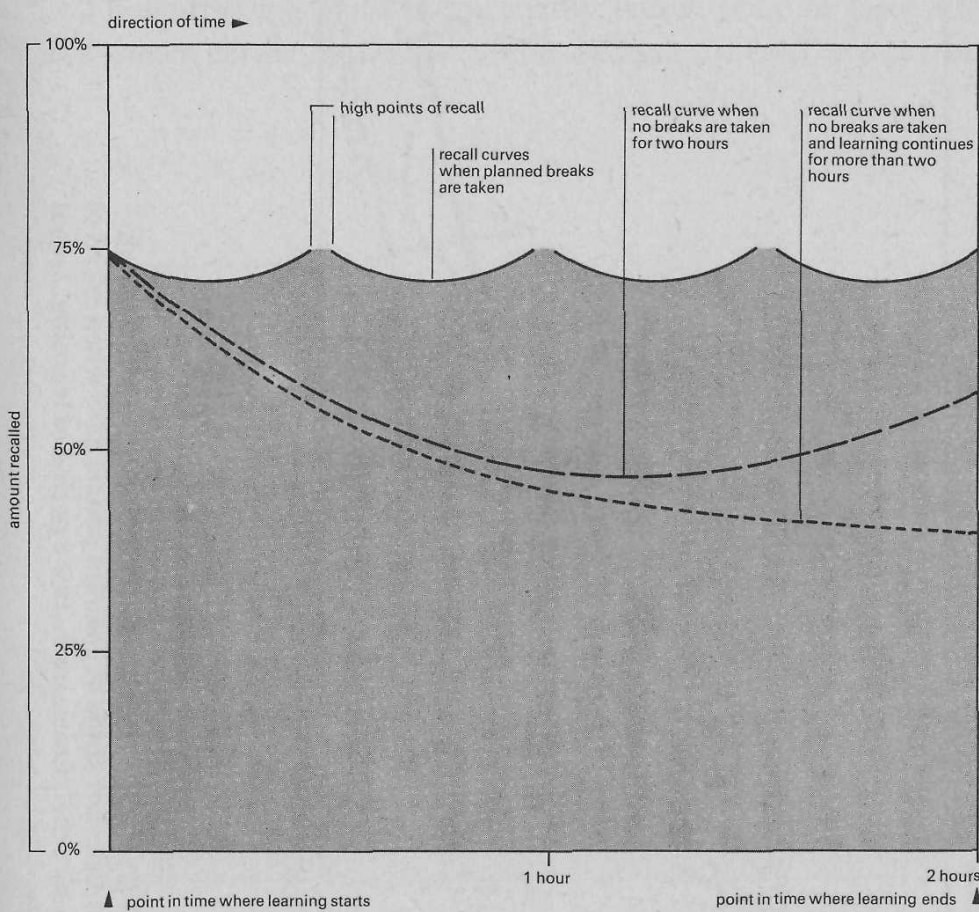
Tony Buzan observed something similar at the level of a single study session: the brain keeps understanding material well even after its ability to recall has begun to slip. The moment the work finally clicks and feels productive is exactly when you should stop.[11]
Why You Come Back Sharper
Perspective, catching mistakes, and letting hard problems incubate
None of this is lost time, which is the part the impatient version of you needs to hear. Stepping away from the work every twenty-five minutes lets you come back and see it from a slightly different angle. That fresh angle is how you catch the mistake you had stopped noticing, and it is how better ideas tend to surface.[4]
It is also how stuck problems come unstuck. Tony Buzan’s account of learning is blunt: “racking your brains” is mostly tension and wasted effort. Letting a difficult problem sit while you do something else gives the brain room to keep working on it underneath.[12]
“Moving on from a difficult area releases the tension and mental floundering that often accompanies the traditional approach.[12]
The next section has the full machinery, but the short version is what matters here: a light, effortless break leaves your mind free to wander, and that is exactly when a missed connection floats up.[5]
When researchers look at how people crack hard problems, stepping away to rest generally beats grinding straight through. The findings are not perfectly unanimous, but the trend is clear.[2] You break so you can return sharper, not just rested.
The Science Underneath: Why Five Minutes Works
The invisible machinery: why even five minutes restores your attention, your recall, and your body
If you want the machinery behind all of this, it comes from three directions that happen to agree: an older learning-science account, modern attention research, and the physiology of movement.
The learning-science view
Buzan describes a break as doing three distinct jobs at once:
- It releases built-up physical and mental tension.
- It lets your recall and your understanding settle back into step.
- It gives material you have just taken in time to consolidate before more lands on top.[12]
Fill the break with demanding activity and you lose all three.
He also points out a memory dividend. Because we remember the beginnings and ends of things best, a long unbroken stretch has only one strong start and one strong finish, while several short sessions with breaks give you many of each.[12]
He reframes the moment your concentration drifts as a signal rather than a failure of will, with the mind telling you it needs a pause.[11]
The attention research
Modern attention research gives the same idea a name. Sustained mental effort fatigues a specific capacity, the directed attention you steer deliberately, and any long stretch of it wears that capacity down.[5]
Sleep alone will not fully refill it. Recovery needs a different mode of attending: the effortless kind. That is why a good break is genuine cognitive work rather than simple idleness.[5]
The strongest evidence for this uses nature. A walk outside or even a view through a window measurably restored people’s attention. Those studies mostly used longer breaks, so a five-minute Pomodoro borrows the principle rather than proving it.[5]
The timing evidence
Decades of rest-break experiments point in the same direction on timing. For working stretches of roughly thirty minutes to two hours, short and frequent breaks beat long and rare ones, and a five-minute pause sits comfortably in that window.[2]
A break tends to pay off most when you are deep into long or difficult work, where it trims the worst lapses. The longer you push on without one, the more your mind wanders. Across many tasks, the proportion of “off-task” moments climbs from roughly one in five early in a stint to about half by the end, and this drift can continue even while your output looks steady, so feeling productive is no proof your attention is holding.[2]
Even automatic, routine work is not safe from that drift. It keeps “increasing the probability of making mistakes” until a break interrupts and refocuses you.[3]
There are two ways to describe why this happens: attention may be a resource that depletes and refills, or a system that becomes satiated and needs a change. They make much the same predictions, so these are better treated as two research traditions with a common core than as rival theories.[2]
The movement layer
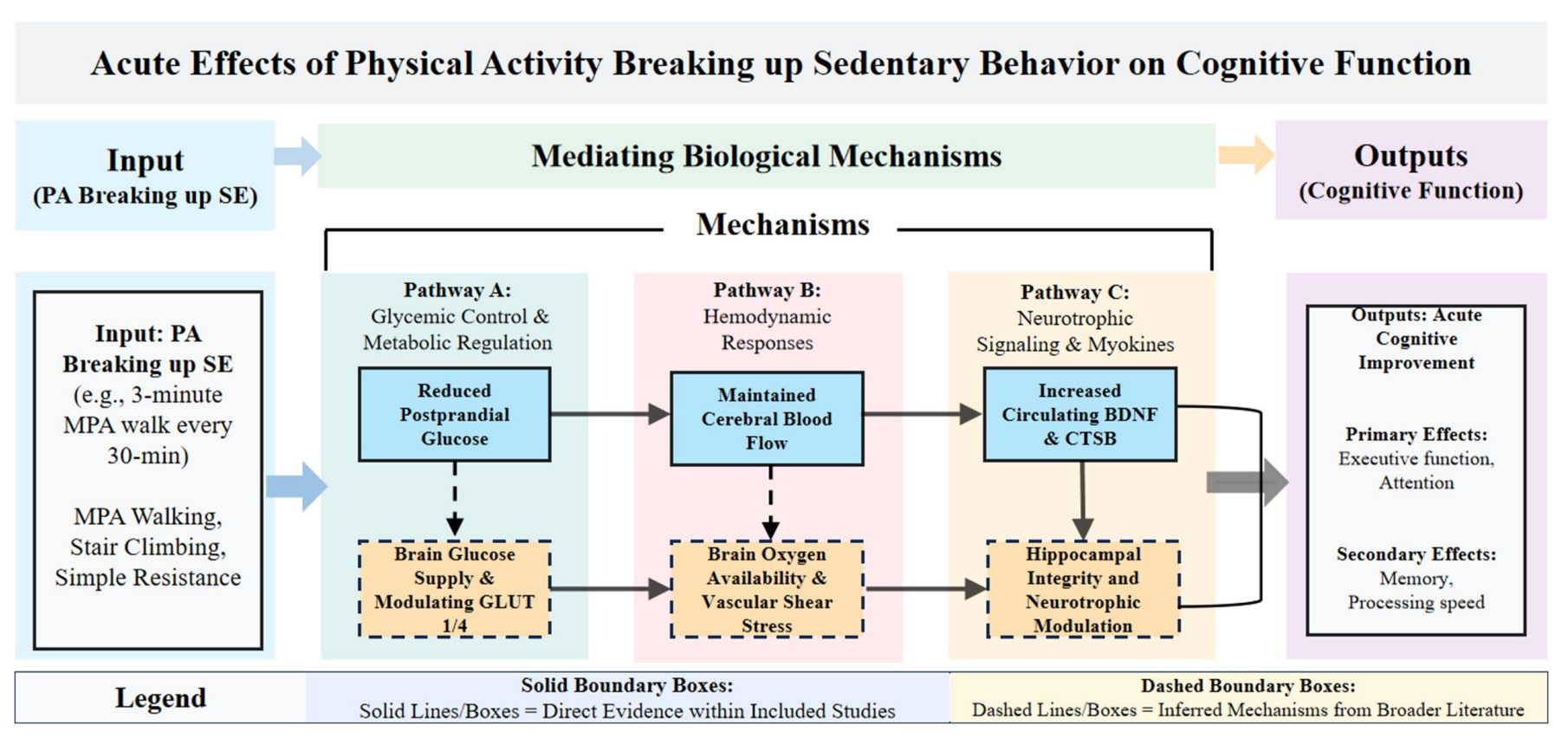
If your break involves moving, there is a physical layer underneath the attentional one. A 2026 review traced the benefit of activity breaks to the body’s supply lines:[9]
- Brief movement helps restore blood flow to the brain.
- It steadies blood sugar.
- It releases signaling molecules that support cognition.
The break is not only resting your attention; it is also topping up the conditions your brain runs on.[9]
“An industrial machine certainly produces more if it works a long time without stopping, but human beings simply don’t function like industrial machines.[4]
Short Break vs. Long Break: Keep the Short One Short
The two break lengths and why the short one must stay short
One last clarification, so the five-minute break isn’t mistaken for the whole system . In Cirillo’s method , the short break is built into the basic Pomodoro unit, not an optional extra. It is just 3 to 5 minutes after each Pomodoro, long enough to disconnect and let the last 25 minutes settle.[4] After every four Pomodoros, he replaces it with a longer break of 15 to 30 minutes for deeper recovery before the next set.[4]
The key rule is simple: keep the short break short. Let it stretch much past five minutes and you break that rhythm.[4] Longer breaks also carry a restart cost: you lose the working mindset and come back less prepared.[2] Deep, high-context work like programming is the common exception, where a longer 50/10 rhythm can suit the work better.
The Real Break Is a Reset, Not a Pause
The one-line answer, and why the putting-down is the point
So the answer to “what do I do for five minutes” turns out to be smaller than the question. You stand up, drink some water, breathe, look out of the window, or take a short walk. The reason any of it works is simple: each small, light action helps you genuinely put down the last twenty-five minutes.
It is the putting-down itself that does the real work, not the specific activity. Do that consistently, and the five minutes pay you back. You return able to see the mistake you were too close to notice and the better idea that wouldn’t come while you were forcing it, precisely because you actually left.
A real break is a reset, not a stopped clock.
References
Sources cited in this article
- 1.Rhee, H., & Kim, S. (2016). Effects of breaks on regaining vitality at work: An empirical comparison of 'conventional' and 'smart phone' breaks. Computers in Human Behavior, 57, 160–167. (Cited on p. 161, and p. 160)
- 2.Schumann, F., Steinborn, M. B., Kürten, J., Cao, L., Händel, B. F., & Huestegge, L. (2022). Restoration of attention by rest in a multitasking world: Theory, methodology, and empirical evidence. Frontiers in Psychology, 13, 867978. (Cited on p. 10, p. 3, p. 9, p. 6, p. 16, pp. 10–11, and p. 11)
- 3.Albulescu, P., Macsinga, I., Rusu, A., Sulea, C., Bodnaru, A., & Tulbure, B. T. (2022). "Give me a break!" A systematic review and meta-analysis on the efficacy of micro-breaks for increasing well-being and performance. PLOS ONE, 17(8), e0272460. (Cited on p. 1, p. 2, p. 17, and p. 18)
- 4.Cirillo, F. (2007). The Pomodoro Technique (Version 1.3). Self-published. (Cited on p. 30, p. 7, p. 31, p. 25, p. 20, and pp. 6–7)
- 5.Kaplan, S. (1995). The restorative benefits of nature: Toward an integrative framework. Journal of Environmental Psychology, 15(3), 169–182. (Cited on p. 173, p. 172, p. 170, and p. 175)
- 6.Mellner, C., Kecklund, G., Kompier, M., Sariaslan, A., & Aronsson, G. (2016). Boundaryless work, psychological detachment and sleep: Does working 'anytime – anywhere' equal employees are 'always on'? In New Ways of Working Practices (Advanced Series in Management, Vol. 16, pp. 29–47). Emerald. (Cited on p. 39)
- 7.Leroy, S. (2009). Why is it so hard to do my work? The challenge of attention residue when switching between work tasks. Organizational Behavior and Human Decision Processes, 109(2), 168–181. (Cited on pp. 168, 178, and p. 179)
- 8.Masicampo, E. J., & Baumeister, R. F. (2011). Consider it done! Plan making can eliminate the cognitive effects of unfulfilled goals. Journal of Personality and Social Psychology, 101(4), 667–683. (Cited on p. 670)
- 9.Li, Y., Jiang, Y., Yin, X., et al. (2026). Acute effects of physical activity breaking up sedentary behavior on cognitive function, biological mechanisms, and practical recommendations: A systematic review. Frontiers in Psychology, 17, 1767939. (Cited on p. 1, pp. 12, 14, p. 13, and p. 13, fig. 3)
- 10.Alghamdi, W. M., & Alrasheed, S. H. (2020). Impact of an educational intervention using the 20/20/20 rule on Computer Vision Syndrome. African Vision and Eye Health, 79(1), a554. (Cited on p. 3)
- 11.Buzan, T. (1983). The Brain User's Guide. Dutton. (Cited on p. 13, and p. 11)
- 12.Buzan, T. (1982). Use your head. Ariel. (Cited on p. 143, p. 131, p. 55, and p. 55, fig. 19)
About the Author
Jonathan Griffin is a productivity writer and developer, and a former UK commercial property solicitor. He works from the primary literature, turning peer-reviewed neuroscience and cognitive science into practical, evidence-based systems for focus and attention, and building the tools that put them into practice.